Turning Biomass into Renewable Molecules
AMBE Energy is developing an integrated thermochemical platform designed to convert lignocellulosic biomass into synthesis gas and subsequently into renewable hydrocarbons and other valuable products.
Rather than developing every technology component independently, our approach focuses on technology integration, Australian feedstock qualification and engineering the interfaces between commercially demonstrated process technologies.
Feedstock Qualification
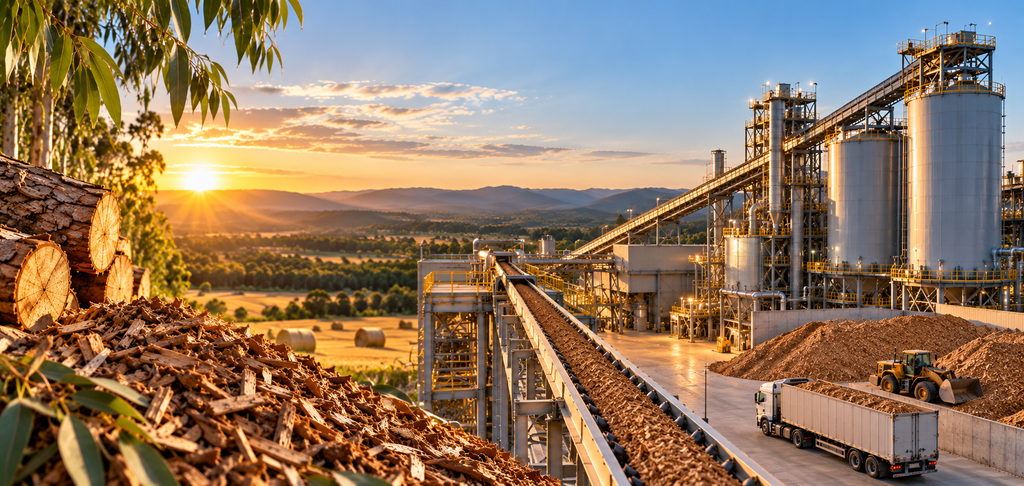
The process begins with understanding the resource. Biomass can vary significantly in moisture, composition, ash content, density, contaminants, particle characteristics and handling behaviour. AMBE Energy's development program evaluates these characteristics and their influence on preprocessing, gasification, syngas quality, process efficiency and downstream conversion.
The initial Victorian development pathway is focused on lignocellulosic forestry residues, with the longer-term platform designed to evaluate additional sustainable biomass resources, including agricultural residues.
Feedstock Preparation
Different biomass resources may require different combinations of sizing, drying, handling, contaminant management, densification or conditioning, together with appropriate storage and logistics strategies.
The objective is not simply to make the platform “feedstock agnostic”, but to establish defined feedstock operating envelopes and appropriate preparation strategies that support reliable downstream process performance.
Gasification
Prepared biomass is thermochemically converted into synthesis gas, principally a mixture containing hydrogen, carbon monoxide and other gaseous components.
AMBE Energy is evaluating gasification technologies against Australian feedstock characteristics, operating performance, scale, integration requirements and commercial deployment capability. Technology selection is being considered as part of the wider integrated process rather than as a standalone unit operation.
Syngas Conditioning
Producing raw synthesis gas is only one part of the pathway. Downstream synthesis requires tightly controlled gas composition and very low levels of contaminants.
AMBE Energy is therefore placing particular emphasis on gas cleaning, tar management, impurity removal, gas composition and conditioning technologies capable of producing synthesis gas suitable for downstream conversion. This interface is central to the integration and performance of the overall platform.
Renewable Fuel Synthesis
Conditioned synthesis gas can be converted through Fischer–Tropsch synthesis into hydrocarbon products that can subsequently be upgraded and refined.
AMBE Energy's initial product-development pathways include Sustainable Aviation Fuel (SAF), renewable diesel and renewable naphtha. Other renewable-molecule opportunities may be evaluated as the platform develops and technology pathways mature.
Carbon & Co-products
Biomass conversion can create additional carbon and energy streams alongside renewable fuels. AMBE Energy is evaluating opportunities for valuable co-products as part of the overall process and lifecycle design.
The development program is focused on understanding how these additional streams may contribute to the technical and commercial performance of an integrated biomass-to-molecules platform.
Australian Biomass → Preparation → Gasification → Conditioned Syngas → Renewable Molecules